
Science
Tongkat Ali Dosage: What Human Studies Actually Used
A source-based record of doses used in selected human Eurycoma longifolia studies — and why extract milligrams are not a recommended dose for dried root-slice tea.
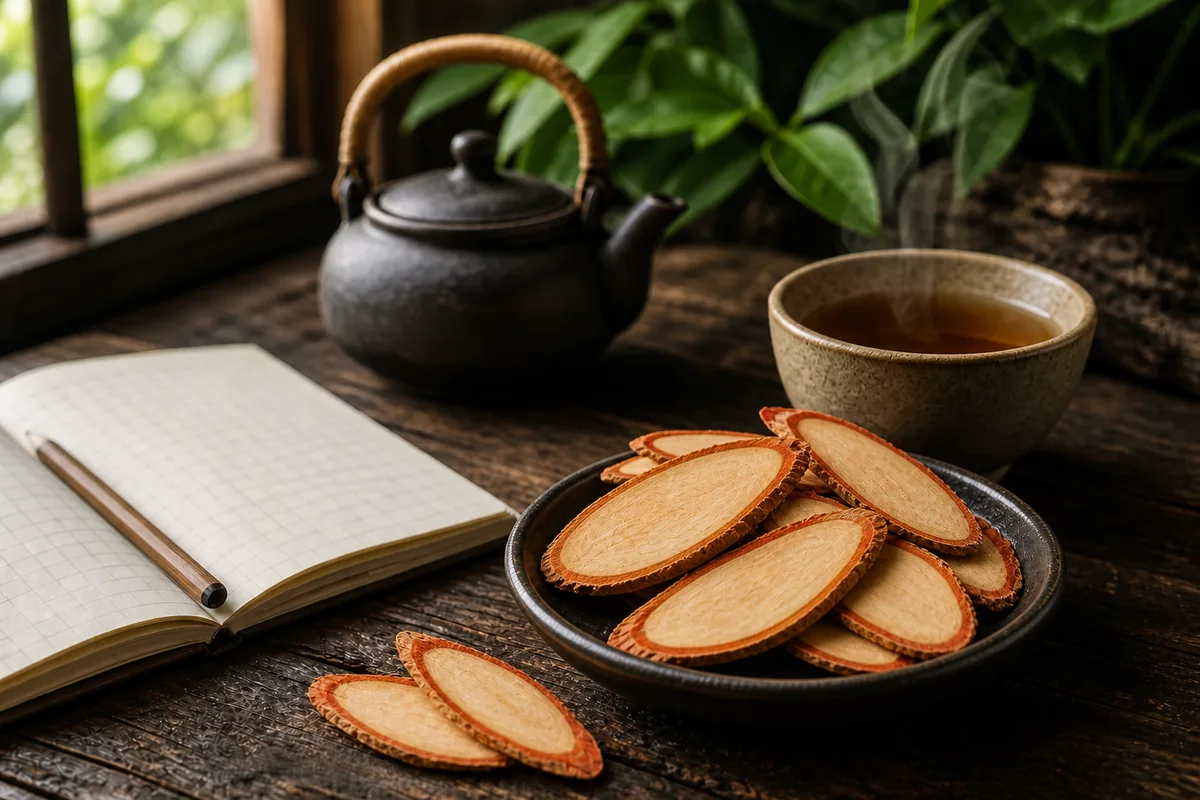
What Tongkat Ali dose did human studies use? Selected studies used particular Eurycoma longifolia supplements at 200 mg or 400 mg per day for defined periods. Those study materials were not dried root-slice tea, and the reported milligrams aren't a recommended or equivalent dose for this product batch.
Direct Answer
Human-study dose describes what a paper tested, not a consumer instruction. The relevant details are the exact material, population, intervention, duration, and outcome. A milligram amount from an extract paper can’t responsibly be translated into grams, slices, cups, colour, or bitterness for an unassayed root tea. The boundary throughout: standardized extract study, dried root tea, and this product batch are three different things.
Selected Human Studies and Reported Doses
| Study | Year/journal | Participants/design | Study material | Reported dose | Duration | Outcome scope | Limitation |
|---|---|---|---|---|---|---|---|
| Leisegang et al. | 2022, Medicina | Systematic review: 9 studies reviewed, 5 RCTs in meta-analysis | Heterogeneous, extract-dominant supplementation literature | Varies by included study | Varies | Possible total-testosterone signal in men | A review can’t define one universal dose or establish root-tea equivalence |
| ADAM trial | 2021 | 45 men; four-arm randomized, double-blind, placebo-controlled | E. longifolia supplement; specification not stated in the PubMed record reviewed | 200 mg | 6 months | Erectile-function and testosterone-related outcomes | Concurrent training was part of the intervention for one arm; not a root-tea study |
| Young-male training trial | 2019 | 40 young men; randomized placebo-controlled | E. longifolia supplement; specification not stated in the PubMed record reviewed | 200 mg daily | 8 weeks | Performance measures and urinary T:E ratio | Training was a co-intervention; urinary ratio didn’t significantly change |
| Physta® crossover trial | 2014 | 13 male recreational athletes; double-blind placebo-controlled crossover | Physta® standardized water extract | 400 mg daily | 6 weeks per regimen, 3-week washout | Urinary T:E ratio; liver and renal measures | Small sample; the result concerns that defined extract, not tea |
Where a material specification isn’t stated in the PubMed record reviewed, we show it as “not stated” rather than filling it in from marketing summaries.
Why Research Dose Isn’t a Recommendation for Root Slices
Converting an extract dose into a root-tea serving would require the tested extract’s verified composition, the chemical composition of the exact root batch, brewing yield, stability through heating, absorption from the resulting drink, and human evidence connecting that exposure to the outcome. We don’t publish those data for our root slices, so we don’t state a clinical dose, cycle, or results timetable for them.
Traditional Preparation Is a Different Question
Our brewing guide describes a traditional food-preparation approach — it doesn’t claim the preparation reproduces any trial protocol, and its slice-count guidance isn’t a conversion from an extract study.
Safety Considerations
Short extract studies can’t establish long-term safety, safety with medicines, or safety for a different preparation. Don’t use a research dose as a reason to increase a root-tea amount. Review Safety, particularly if you take medicines or have a health condition.
FAQ
What dose of Tongkat Ali did human studies use? Selected human studies used particular supplements at 200mg or 400mg per day for defined periods. These were study-specific preparations, mainly extracts, and are not a recommended or equivalent dose for dried root-slice tea.
Can an extract dose be converted into root slices? No. Converting an extract dose into slices would require matched batch composition, brewing yield, stability, absorption, and clinical evidence. Those data are not published for our root slices.
Sources and Related Reading
Evidence Index · Tongkat Ali and Testosterone · Root Slices vs Extract · Drug Interactions · What We Test
Educational information, not medical advice. This product has not been evaluated by the FDA and is not intended to diagnose, treat, cure, or prevent any disease.
Frequently Asked Questions
Scientific research and product-specific testing answer different questions. See Product Batch Testing.