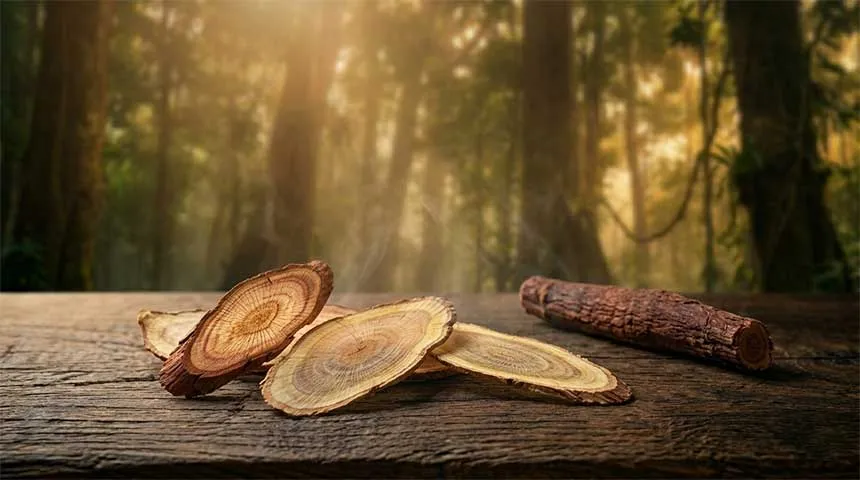
You spend twenty minutes reading a supplement label — extraction ratio, standardised percentage, third-party tested — and still walk away unsure whether what you have ordered is genuinely potent or a beautifully packaged disappointment. That uncertainty is especially sharp with wild vs farmed Tongkat Ali, because the difference rarely appears on the label at all, yet it may be the single biggest variable affecting what you actually feel.
Wild vs Farmed Tongkat Ali: What the Terms Actually Mean
Wild-harvested Tongkat Ali refers to Eurycoma longifolia roots collected from old-growth rainforest — typically in the highland regions of Pahang, Kelantan, or Terengganu in Peninsular Malaysia. These trees grow slowly, often over fifteen to twenty-five years, before any harvesting takes place. Roots are dug by hand, usually by Orang Asli communities or trained harvesters who can identify which specimens have reached the maturity needed for full potency.
Farmed Tongkat Ali is cultivated in managed plantations. Seeds are germinated in nurseries, transplanted to agricultural land, and harvested on a commercially driven schedule — often within three to five years of planting, sometimes less.
The gap matters because Eurycoma longifolia is not a passive plant. Like many medicinal herbs, it produces higher concentrations of its active compounds — primarily eurycomanone and related quassinoids — in response to the stresses of a wild environment: nutrient-poor soil, competition for light, seasonal drought, and slow growth over many years. A plantation tree harvested at four years has not had the time to accumulate those compounds at the same depth as a wild specimen twice its age.
Why Root Age Is the Variable That Determines Eurycomanone Levels
The bioactive compounds in Tongkat Ali studied most extensively are quassinoids, particularly eurycomanone. These bitter-tasting molecules are widely attributed to the root’s documented effects on testosterone support, stress modulation, and energy metabolism.
Two factors dominate how much eurycomanone a root contains: age and environmental stress. Neither is visible on a finished supplement label.
A 2011 review by Bhat and Karim, published in Food Chemistry, noted that the bioactive content of E. longifolia varies considerably by geographic origin, plant age, and plant part — with mature wild roots from highland forest consistently showing the highest quassinoid concentrations. A study by Chan and colleagues (2009) in the Asian Pacific Journal of Tropical Biomedicine found that root samples varied substantially in eurycomanone content depending on collection site and estimated plant age. Rehman and colleagues (2016), writing in the journal Molecules, further documented that quassinoid yield in E. longifolia is directly influenced by ecological growing conditions — supporting the conclusion that controlled cultivation produces a measurably different phytochemical profile from wild-forest specimens of comparable size.
The same pattern appears across adaptogenic herbs broadly: slow-growing plants under natural stress produce denser, more complex phytochemical profiles than their cultivated counterparts.
Key insight: Eurycomanone concentration is not fixed at a species level. It accumulates over years, under stress — exactly what a wild highland forest provides, and what a fast-cycle plantation cannot replicate.
Why Extraction Ratios Can Mislead You About Quality
Most Tongkat Ali marketing leads with extraction ratios — 100:1, 200:1 — and standardised eurycomanone percentages. These figures create an impression of rigorous quality control. They do not tell you whether the source material was potent to begin with.
A young farmed root can be processed into a 200:1 extract. The ratio describes only the concentration step — not the starting quality of what was concentrated. A root slice from a twenty-year-old wild tree, sold whole and unextracted, may deliver a comparable or superior eurycomanone profile without any of the concentration theatre.
Traditional use in Malaysia has always centred on the whole root, boiled slowly as a decoction. That practice was built on wild trees at full maturity, a context predating plantation farming by centuries. For more on how this preparation works, see our guide on how to brew Tongkat Ali root properly.
Side-by-Side: Wild-Harvested vs Farmed Tongkat Ali
| Factor | Wild-Harvested | Farmed/Plantation |
|---|---|---|
| Typical root age at harvest | 15–25+ years | 3–7 years |
| Eurycomanone concentration | Generally higher | Variable; often lower |
| Quassinoid profile | Complex, full-spectrum | Narrower, less developed |
| Environmental stress markers | Present | Absent or minimal |
| Sustainability | Requires managed harvesting | More controllable supply |
| Cost | Higher | Lower |
| Availability | Scarcer | Widely available |
| Label transparency | Rarely disclosed | Rarely disclosed |
Neither wild nor farmed root is inherently fraudulent. But they are not equivalent products, and marketing that presents them as interchangeable does consumers a genuine disservice.
How to Assess Origin and Quality Before Buying
Given that the wild-versus-farmed distinction is rarely disclosed upfront, the responsibility falls on the buyer to ask the right questions. Here is a practical checklist:
| Question to Ask | What a Credible Answer Looks Like |
|---|---|
| What species is used? | Eurycoma longifolia — variety specified (red, yellow, or black) |
| Where is the root from? | A named Malaysian state or region (e.g. Pahang, Kelantan) |
| Wild-harvested or farmed? | Wild-harvested, with a traceability statement |
| Approximate root age? | 15+ years for wild; disclosed for farmed |
| Whole root or extract? | Whole root slices retain the full phytochemical spectrum |
| Third-party testing? | Lab verification of eurycomanone or quassinoid content |
A seller who cannot answer most of these questions is probably not sourcing with any real care. For a broader guide to evaluating Tongkat Ali products, see our article on what Tongkat Ali is and how to use it.
Worth knowing: A label reading “standardised to 2% eurycomanone” tells you the end concentration — not the age or quality of the raw material used to reach it. Whole root slices from mature wild trees offer a transparency that concentrated extracts often obscure.
For a deeper comparison of whole-root and extract formats, see our article on Tongkat Ali root vs extract.
Why Pahang Produces Some of the Most Potent Wild Red Tongkat Ali
The Red variety of Eurycoma longifolia — distinguished by its reddish bark and the deep red-brown colour of its dried slices — is traditionally regarded in Malaysian herbalism as among the more potent preparations of the root. It grows in the highland forest zones of Pahang, where altitude, thin acidic soils, and dense canopy shade create exactly the slow-growth, high-stress conditions associated with richer phytochemical development.
Region matters in a practical sense as well. Malaysian forest E. longifolia has been the subject of the vast majority of published Tongkat Ali research. When you read a clinical study, the root used was almost certainly Malaysian in origin — which means results from those trials are most directly applicable to Malaysian-sourced product.
For context on variety differences, see our article on Red vs Yellow vs Black Tongkat Ali.
Wild Red Tongkat Ali root slices from Pahang, Malaysia — from $59.90 USD →
The roots sold here are harvested from mature wild trees in Pahang’s highland forest, dried traditionally, and sold as unprocessed slices — no extraction, no fillers, no concentration steps that obscure what the source material actually is.
The Sustainability Question: What Responsible Wild Sourcing Requires
Presenting wild-harvested Tongkat Ali as simply superior would be incomplete without acknowledging the ecological reality. Eurycoma longifolia is subject to protection regulations in Malaysia, and overharvesting has been a documented concern in commercially accessed forest areas.
Responsible wild sourcing requires harvesting only mature specimens above a minimum size threshold, leaving sufficient reproductive trees in each area, working with Orang Asli communities who have managed these forests knowledgeably for generations, and avoiding protected reserves.
Farmed Tongkat Ali, harvested at appropriate maturity — seven to eight years at minimum — is a legitimate product that reduces pressure on wild populations. The problem is not farming itself, but the combination of very short harvest cycles and marketing that presents a three-year plantation root as equivalent to a twenty-year wild specimen.
For more on the traditional and cultural background of Tongkat Ali’s use, see our article on Tongkat Ali’s Malaysian origin and heritage.
Does Wild Tongkat Ali Produce Noticeably Different Results After 50?
Direct clinical trials comparing wild versus farmed Eurycoma longifolia in human subjects do not yet exist — a genuine gap in the research. What does exist is consistent phytochemical evidence that wild, mature roots contain higher and more complex quassinoid profiles. Since the clinical effects studied in humans — testosterone support, cortisol modulation, improved energy — are attributed to those same quassinoids, the inference is straightforward: a richer source material is more likely to produce a meaningful effect.
For adults over 50, whose baseline testosterone and energy levels are already on a declining trajectory, the margin between a potent root and a dilute one matters more than it would for a younger person. A plantation root at minimum eurycomanone levels may not be enough to move the needle. This is the practical argument for wild-sourced material — not that farmed root is inert, but that the buffer against inadequacy is smaller.
For men, our article on Tongkat Ali for men over 50 covers realistic expectations based on the published research. For women, particularly post-menopausal, the article on Tongkat Ali for women addresses the specific considerations for that group.
The One Question That Reveals Whether a Seller Knows Their Source
When comparing Tongkat Ali products, the single most revealing question is not “what is the extraction ratio?” It is: how old was the root at harvest, and was it wild or farmed?
A seller who can answer that question with specificity — backed by a named sourcing region and some form of phytochemical testing — is operating at a different standard from one who leads only with ratios and certification logos. The wild vs farmed distinction is the most under-discussed quality variable in the Tongkat Ali market. It is also the one most likely to explain why some people report clear results and others notice nothing at all.
Wild Red Tongkat Ali root slices from Pahang, Malaysia — from $59.90 USD →
⚠ Disclaimer: This article is for educational purposes only. Tongkat Ali is not approved by the FDA, UK MHRA, TGA, or any regulatory body to treat any medical condition. Consult your healthcare provider before use.