
Blog
Where to Buy Red Tongkat Ali in the USA (2026 Guide)
Looking for Red Tongkat Ali root slices in the USA? What to check before buying, how root slices differ from extracts, real shipping times, and how checkout works.
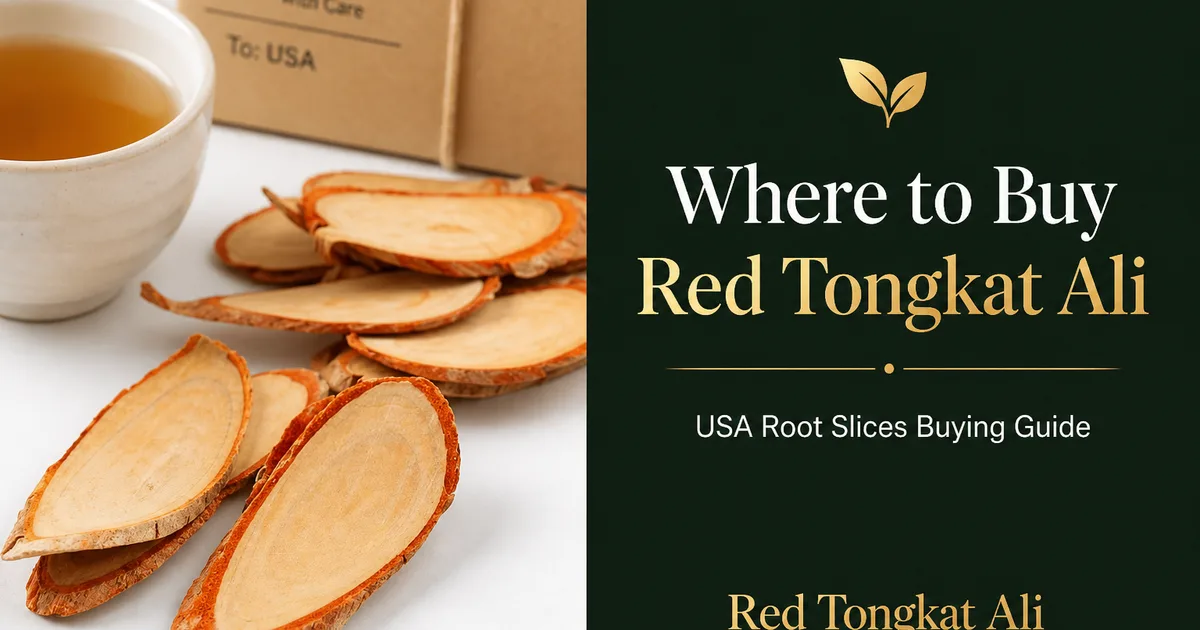
Short answer: Red Tongkat Ali Malaysia (redtongkatalimy.com) sells dried Malaysian Red Tongkat Ali root slices for tea — not a standardized extract. US all-in checkout pricing is $119 (500g), $179 (1kg), and $289 (2kg), shipping included. Order directly on our Shop by card, Apple Pay, Google Pay, or USDT (5% off); tracked delivery from Malaysia typically takes 10–28 days. We have not published a batch COA; see What We Test.
If you’re searching for Red Tongkat Ali in the United States, the first decision isn’t which benefit claim sounds strongest — it’s whether you want a whole dried root product you can inspect and brew yourself, or a concentrated extract in a capsule. Our Red Tongkat Ali is sold as dried Malaysian root slices for tea preparation — not capsules, not a standardized extract, and not a medicine.
What “Red Tongkat Ali” Actually Means
“Red Tongkat Ali” is a trade label used in Malaysian commerce and tradition. It’s not a laboratory guarantee of a separate species, a dosage standard, or a medical effect. Our product is Malaysian dried root slices sold under this trade name — we don’t publish batch-level botanical identification, and we don’t claim that extract research applies directly to brewed whole-root tea.
Before buying any product sold under this name, check three things: the form (whole root slices, powder, or an extract capsule), the origin statement (a seller should say what it is and where it’s from), and the evidence limits (extract research shouldn’t be presented as proof that root tea has the same effect). More on naming: What Is Red Tongkat Ali? and Red vs Yellow vs Black.
Root Slices vs. Extract Capsules
| Root slices | Extract capsules | |
|---|---|---|
| What is it? | Cleaned, sliced, dried root | Processed and concentrated powder |
| How is it used? | Simmered as tea | Taken in measured capsule servings |
| What can you inspect? | Cut surface, fiber, aroma, packaging | Mostly the label and documentation |
| What does clinical research use? | Rarely | Most Tongkat Ali trials use extracts |
Neither format automatically makes a better product — a root-slice buyer values traditional preparation and being able to see the plant material, an extract buyer values convenience and a stated serving size. What matters is the seller being clear about which one they’re selling. Full comparison: Tongkat Ali Root vs. Extract.
A Practical Buying Checklist
Check the product form before reading the claims. “Tongkat Ali” can mean loose root, powder, tea bags, capsules, or standardized extract — confirm the listing actually sells the form you want, and be wary of sellers using extract-study language to imply whole root is a standardized dose.
Look for a specific origin statement. Origin alone doesn’t prove quality, but it’s a basic traceability question. We state our root slices are sourced from Pahang, Malaysia — be cautious of listings that skip origin entirely or lean only on generic “premium” language.
Treat “red,” “wild,” and extraction ratios as descriptions, not proof. These terms are useful starting points, but they don’t replace botanical identification, batch documentation, or honest labeling.
Ask for a batch COA if lab documentation matters to you. We have not published a batch Certificate of Analysis for these slices — current status on What We Test.
Read the price and shipping terms before checkout. Low headline prices can exclude international postage or add charges later. Our US prices are all-in checkout prices:
- 500g: $119
- 1kg: $179
- 2kg: $289
Be skeptical of disease-treatment promises. In the US, disease claims can place a product in drug-regulation territory. Herbal products shouldn’t be purchased as a substitute for medical care.
Real Shipping Times
Rather than a vague “fast shipping” promise, here’s an actual tracked shipment from Malaysia to Arizona: shipped from Shah Alam via UPS Worldwide Express Saver, cleared US customs in Ontario, CA (including a routine USDA agricultural inspection step), and delivered in Litchfield Park, AZ 12 days later. Full details, including how the product legally clears USDA plant quarantine and FDA import requirements, are on our US Import & Compliance page — worth reading if you’ve wondered whether this can legally reach you.
How to Order
- Open the Shop and choose 500g, 1kg, or 2kg — the US price already includes tracked shipping.
- Pay by card, Apple Pay or Google Pay in secure Stripe checkout, or choose Pay with USDT (TRC20) to save 5%.
- Enter your US delivery address; you’ll get a confirmation email and, once the parcel leaves Malaysia, a tracking number.
- Brew the slices as tea after delivery — see How to Brew Tongkat Ali.
Larger packs lower the price per gram, but the right first purchase depends on how often you’ll brew and whether you’ve tried the flavor before. Whole root tea can be mildly bitter; bitterness isn’t proof of authenticity or potency, and the largest pack isn’t automatically the right starting point.
Bottom Line
A trustworthy Red Tongkat Ali listing should say clearly whether it’s root or extract, state its origin, avoid disease claims, and show the real checkout price. If you want traditional tea preparation and a product you can inspect before brewing, open the US commercial page to choose a pack.
Also useful: Shop · What We Test · Root vs extract · US Import & Compliance
This article is educational information, not medical advice. This product has not been evaluated by the FDA and is not intended to diagnose, treat, cure, or prevent any disease. Consult a qualified healthcare professional before use if you have a medical condition, are pregnant or breastfeeding, or take prescription medication.