
Blog
What Does 200:1 Tongkat Ali Mean? Extract Ratios & Eurycomanone % Explained
What 200:1, 100:1 and 2% eurycomanone on a Tongkat Ali label really mean, why a ratio is not a strength rating, what to ask a seller, and how whole root slices differ.
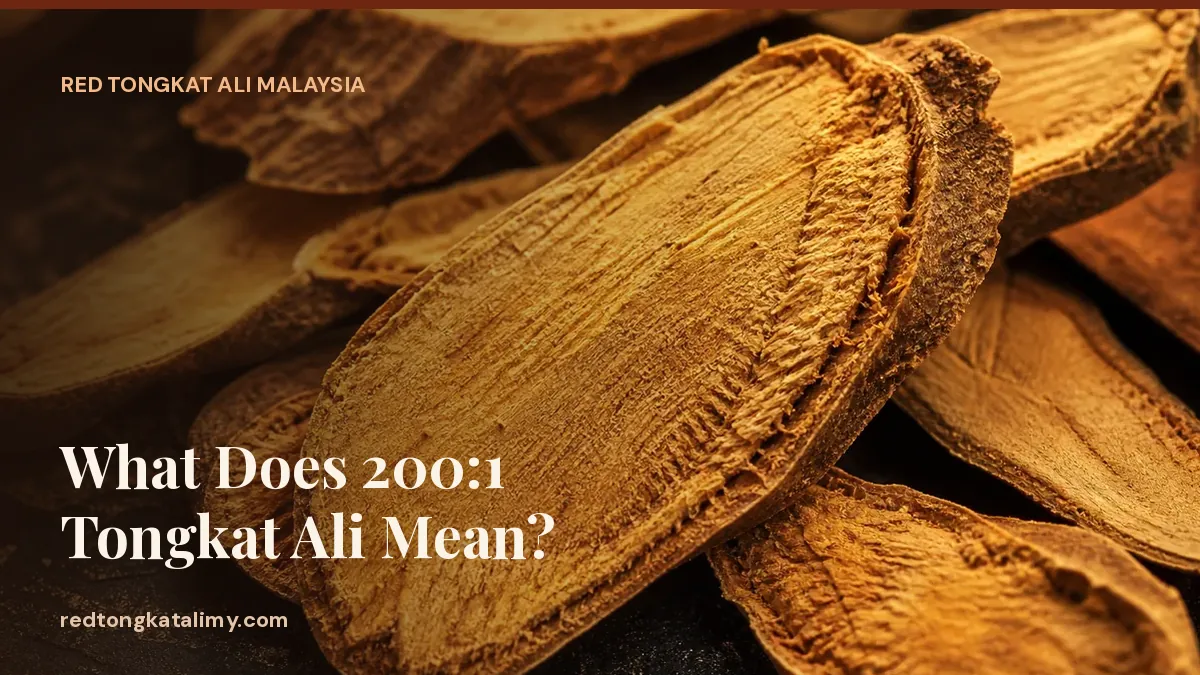
What does 200:1 Tongkat Ali mean? It is a claimed extraction ratio — about 200 kg of raw root said to be concentrated into 1 kg of extract. It is not a potency score, not "200 times stronger," and nobody independently verifies it. What tells you more is a published batch test showing the marker compounds actually present. Whole root slices, like ours, are unextracted and have no ratio at all.
The Three Numbers You See on Labels
| Label claim | What it describes | What it does not tell you |
|---|---|---|
| 200:1, 100:1, 50:1 | Weight of raw root claimed per unit of extract | Which compounds are present, or how much |
| 2% (or 10%) eurycomanone | Claimed share of one marker compound | Whether a lab verified it for that batch |
| 400 mg per capsule | Weight of powder in the capsule | How much is extract versus filler |
Why a Ratio Is Not a Strength Rating
An extraction ratio only compares weights. Whether the result is “strong” depends on things the ratio hides: the solvent (water or alcohol), temperature and time, which parts of the root were used, and how much carrier powder was added afterwards to make the extract flow. A seller can reach a high ratio simply by removing more inert material — or by picking a flattering number.
That is why extract quality is normally described by standardization: a laboratory measures marker compounds and reports them on a certificate of analysis. If you are comparing capsules, ask for that document. Our guide to reading a Tongkat Ali COA explains what to look for.
What About Eurycomanone Percentages?
Eurycomanone is the best-known quassinoid in Eurycoma longifolia and is widely used as a marker. A stated percentage is useful only when it comes with a method and a batch result. It is also not a “more is better” dial: human studies tested particular extracts at particular doses, and nobody has shown that simply raising one marker improves results. See eurycomanone in context.
Questions Worth Asking an Extract Seller
- Can I see the certificate of analysis for the batch I’m buying?
- What was the extraction solvent — hot water, or something else?
- How much of each capsule is extract, and what else is in it?
- Is there a contaminant panel (heavy metals, microbes)?
- Which published study, if any, used this same extract?
Where Root Slices Fit
Slices sit at the other end of the spectrum: nothing has been extracted, concentrated or standardized. You see the root, you simmer it, and you decide the strength by how many slices you use and how long you brew. The trade-off is honest and simple — you gain visibility of the ingredient, and you give up a measured, standardized dose.
Being equally direct about our own product: we sell dried Red Tongkat Ali root slices, we do not publish a ratio or a eurycomanone figure for them, and we do not currently publish a batch lab report (what we test). Extract-study doses cannot be converted into slices.
Related: Root slices vs extract · How to brew · Dosage: what human studies used
Educational information only, not medical advice. These statements have not been evaluated by the FDA. This product is not intended to diagnose, treat, cure, or prevent any disease.
Frequently asked questions
What does 200:1 mean on Tongkat Ali?
Is 200:1 Tongkat Ali stronger than 100:1?
What does 2% eurycomanone mean?
Is a higher eurycomanone percentage better?
Do Tongkat Ali root slices have a ratio like 200:1?
How many root slices equal one 200:1 capsule?
Is Red Tongkat Ali sold as capsules or extract?
Ready to brew the real root?
500g, 1kg or 2kg of Malaysian Red Tongkat Ali root slices — tracked shipping to the USA included. Pay by card or USDT (5% off).
Shop root slicesLost or damaged? Free reship · Secure Stripe checkout · One-time purchase, no subscription