
Blog
Red Tongkat Ali Root Slices vs Tongkat Ali Extract: Evidence & Format Differences
Tongkat Ali root slices vs extract capsules: how whole root tea differs from 100:1 and 200:1 extracts, what studies used, cost per day and which to choose.
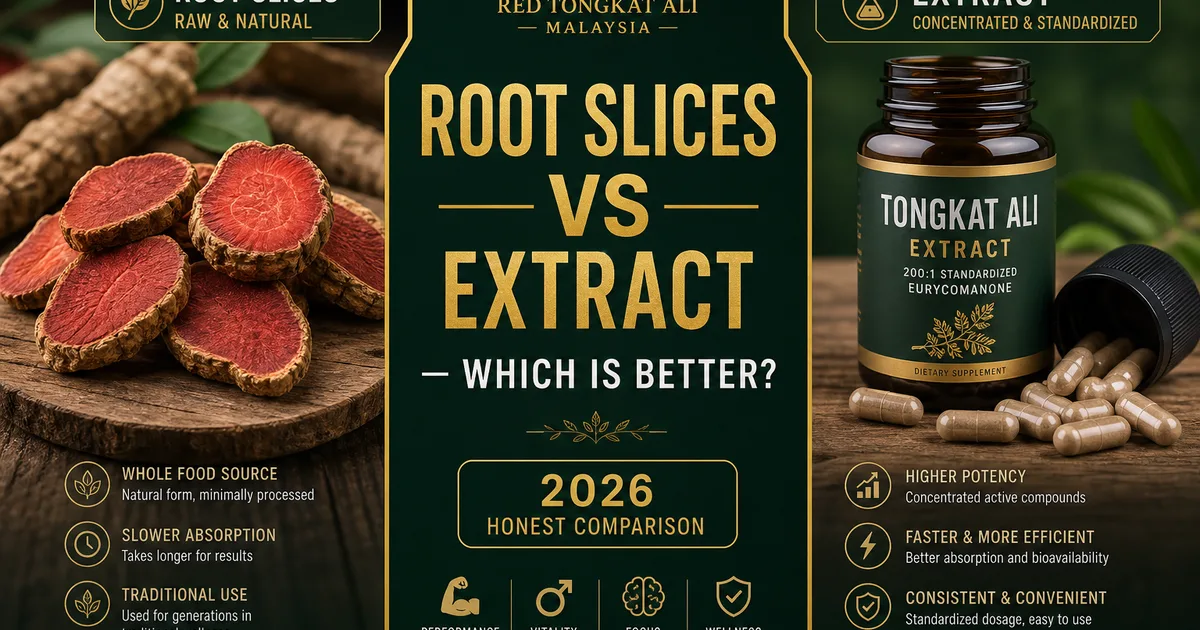
Root slices vs powder vs extract: Shoppers usually choose among three formats — dried root slices for tea, whole-root powder, and standardized extract (often capsules). Most human trials use extracts with stated doses. Ratio and marker-% labels on extracts (e.g. 200:1 or 2% eurycomanone) don't apply to our unstandardized root slices, and extract-trial results don't automatically establish dose, chemistry, or outcomes for unassayed Red Tongkat Ali root-slice tea.
If you’re buying: want tea you brew yourself and can inspect as cut root? Choose dried root slices. Want documented extract specs? Look for a seller that publishes a batch COA. Our product is slices only (not powder, not extract) — batch COA not published, see What We Test.
Format Comparison
| Feature | Dried root slices | Whole-root powder | Standardized extract |
|---|---|---|---|
| What it is | Cut dried root pieces | Ground whole root | Concentrated extract (often capsules) |
| How used | Brew/simmer as tea | Mix or brew | Measured serving |
| What you can inspect | Cut surface, bark, fiber | Mostly powder appearance | Label and published docs |
| Our product | Yes | No | No |
| Research | Rare as tea | Often not the trial material | Most human trials |
| Docs/COA | Ours: not published | Ask the seller for that lot | Sometimes published |
Powder isn’t the same as slices — particle size, brewing behaviour, and how much of the cut surface you can inspect all differ. Extract powder also isn’t whole-root powder: a standardized extract is a processed concentrate, while a ground root is still whole-root material in powder form. Taste and colour of tea or powder are sensory cues only — not an assay of eurycomanone or any other marker.
What Do 200:1, 2%, and 10% Eurycomanone Mean?
Extraction ratios (e.g. 200:1) are marketing shorthand for a claimed relationship between starting plant material and finished extract weight — they’re not automatic proof of being “200× stronger,” and they don’t describe our unstandardized root slices. Marker percentages (e.g. 2% eurycomanone) are meaningful only when a seller publishes a method and result for that specific extract batch, and can’t be transferred to unassayed root-slice tea. See eurycomanone research context.
Our slices: no published extraction ratio, no published eurycomanone %.
What Is Known
Human research on Eurycoma longifolia is limited and generally extract-based: PubMed 36013514. We sell dried root slices for tea and don’t publish a batch COA, DNA ID, or eurycomanone % — What We Test. Brewing root as tea is a long-standing food practice, separate from clinical dosage.
What’s Uncertain
Chemical equivalence of tea to any studied extract, clinical outcomes for this exact tea, and whether a marketing extraction ratio equals a researched material all remain unestablished.
Practical Buyer Questions
Do you want inspectable tea root, whole-root powder, or a documented extract? Is a batch COA essential to you (ours isn’t published)? Are extract headlines being sold as if they were root-tea results?
Related
How to prepare · What We Test · What is Red Tongkat Ali? · Where to buy in the USA · Evidence Index
Educational information, not medical advice. This product has not been evaluated by the FDA and is not intended to diagnose, treat, cure, or prevent any disease.
Keep reading: What does 200:1 mean? · Root slices vs powder vs tea bags
Frequently asked questions
Is extract "better"?
Does 200:1 mean 200× stronger tea?
How much does Red Tongkat Ali tea cost per day?
Where can I buy Red Tongkat Ali root slices in the USA?
Ready to brew the real root?
500g, 1kg or 2kg of Malaysian Red Tongkat Ali root slices — tracked shipping to the USA included. Pay by card or USDT (5% off).
Shop root slicesLost or damaged? Free reship · Secure Stripe checkout · One-time purchase, no subscription