
Blog
Tongkat Ali Benefits: What Evidence Shows — and What It Doesn't
Tongkat Ali benefits are often marketed as settled. This page maps common claims to extract research, then states what's not established for root tea or this batch.
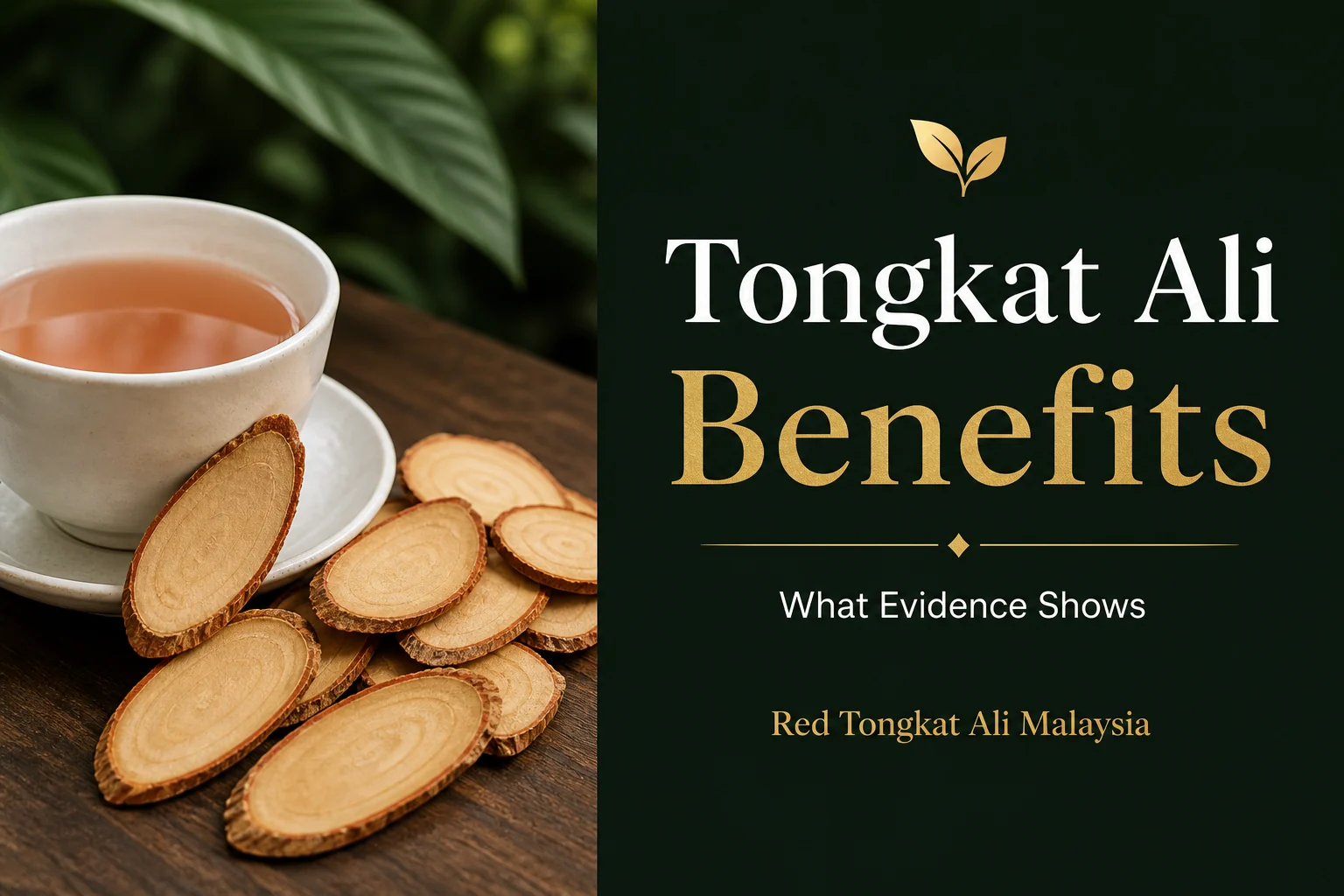
Tongkat Ali benefits: Published human research on Eurycoma longifolia is limited and mostly evaluates standardized extracts at measured doses. Those findings inform a discussion of the studied materials — they don't establish benefits, dose, or a timetable for tea made from unassayed dried root slices, and they don't prove an effect for this product batch.
Start With the Product, Not the Headline
“Tongkat Ali benefits” is a search phrase, not a single intervention. Listings may sell extract capsules, powders, combination formulas, tea bags, or whole dried root — traditional brewing of root as tea is a food practice, while most clinical papers evaluate manufactured extracts. These aren’t interchangeable. A useful reading order: what material was studied, in whom and at what dose, what outcome was measured, and what remains unproven for root tea and this seller’s current batch. No Tongkat Ali product should be used to diagnose, treat, cure, or prevent a disease — fatigue, low libido, sleep problems, and mood changes have many medical causes.
What the Evidence Says
Human evidence is sparse, often short, and heterogeneous. A 2022 systematic review and meta-analysis of Eurycoma longifolia and testosterone reported a possible effect on total testosterone while calling for stronger trials: PubMed 36013514. Included products were mainly extracts — that paper doesn’t set a tea serving, a root-slice milligram equivalent, or an outcome for our slices.
A handful of other trials are worth naming, all indirect for dried-root tea: a randomized trial with training arms reported erectile-function and testosterone-related outcomes using a 200mg E. longifolia supplement over six months (PubMed 33541567), though concurrent training was a co-intervention; a 12-week sexual-performance trial used a combination containing Physta® extract plus Polygonum minus, not Tongkat Ali alone (PubMed 24550993); and a small crossover study of Physta® water extract examined urinary testosterone markers rather than broad benefit outcomes (PubMed 25013692). None of these are root-tea studies, and none establish outcomes for our product.
Endpoint-specific reviews live on our science pages: Tongkat Ali and testosterone · Tongkat Ali and libido · Tongkat Ali and cortisol · Tongkat Ali dosage.
What the Evidence Doesn’t Establish
For Tongkat Ali tea, or for this batch specifically, the evidence doesn’t establish: a clinically defined benefit, dose, or onset timetable for brewed dried root; chemical or clinical equivalence to any studied extract; treatment of low testosterone, erectile dysfunction, infertility, depression, or insomnia; or that bitterness, brew colour, or origin statements prove potency. Absence of a reported problem in a small extract study is also not a safety guarantee for a different preparation.
Root Slices Versus Extract
People searching for “Tongkat Ali tea” are usually looking for dried root to simmer. Most human trials look at capsules or defined extract powders — format, concentration, and serving are different questions, and extract milligrams from a paper can’t be converted into a handful of slices. There’s no published eurycomanone percentage for our current lot. See Tongkat Ali root vs extract.
This Product Batch
We sell Malaysian dried Red Tongkat Ali root slices as a food for brewing. “Red Tongkat Ali” is traditional and commercial terminology — it’s not a published DNA certificate for this lot. Product testing for this batch is not currently published: we don’t claim a batch COA, contaminant panel, DNA identification, or measured marker percentage. Read what we test before deciding whether that uncertainty is acceptable to you.
Evaluation Checklist
Is the listing an extract, a blend, or whole-root tea? Does the seller point to a study of that material, or generic plant-name research? Is a batch COA available for the exact lot you’d receive? Are disease-treatment promises being used as a reason to buy? If you can’t answer the first three, pause — marketing language won’t replace those facts.
Related Authority Pages
Evidence index · Research hub · Human studies · What is Tongkat Ali? · How to brew
If dried root slices for tea are the format you want, and you’ve read the testing status, the US commercial page is the next step — not a claim that benefits are proven for this tea.
Educational information, not medical advice. This product has not been evaluated by the FDA and is not intended to diagnose, treat, cure, or prevent any disease. Ask a qualified clinician before using an herbal product if you are pregnant or breastfeeding, have a medical condition, or take prescription medicine.