Most people who start taking Tongkat Ali are not impatient by nature — they have already tried the quick fixes. What they want to know is whether this plant is the real thing, and if so, how long they should reasonably wait before expecting to notice something. How long does Tongkat Ali take to work is one of the most common and most honest questions asked about this root, and it deserves a direct, evidence-based answer rather than marketing optimism.
The short answer: most adults report noticing early changes within two to four weeks, with more meaningful results — particularly around energy, mood, and hormonal markers — appearing between four and twelve weeks of consistent use.
What Tongkat Ali Actually Does in the Body
Before looking at timing, it helps to understand what Eurycoma longifolia — the botanical name for both red and yellow Tongkat Ali — is actually doing once you begin taking it. This is not a stimulant that floods your bloodstream with adrenaline. It works through slower, more systemic pathways.
The root’s primary active compounds, known as quassinoids (particularly eurycomanone), appear to support the body’s natural hormone-signalling processes. Research suggests E. longifolia may reduce levels of sex-hormone-binding globulin (SHBG), allowing more free testosterone to circulate. It also appears to influence cortisol regulation — the stress hormone that rises sharply in midlife and suppresses many of the functions older adults most want to preserve.
Because these mechanisms work at a hormonal and cellular level rather than a neurological one, the effects accumulate gradually. Think of it less like taking a painkiller and more like beginning a new exercise routine — the changes are real, but they take weeks to become apparent.
For a fuller explanation of the plant’s biology and compounds, see our article on what Tongkat Ali is and how it works.
The Week-by-Week Timeline: What Research and User Reports Suggest
The following timeline is a reasonable guide based on published clinical studies and the common experiences reported by adults in the 45–70 age range. Individual results vary considerably depending on baseline hormone levels, body weight, form of Tongkat Ali used, and consistency of intake.
| Timeframe | What You May Notice |
|---|---|
| Days 1–7 | Little to no perceptible effect for most people; occasional mild increase in alertness |
| Weeks 2–3 | Early improvements in sleep quality or morning energy for some users |
| Weeks 4–6 | More consistent energy levels; reduced afternoon fatigue; improved mood stability |
| Weeks 8–12 | Measurable hormonal changes in studies; libido improvements more commonly reported |
| Months 3–6 | Cumulative benefits — physical endurance, body composition, stress resilience |
Key insight: Tongkat Ali is not a one-dose herb. The clinical studies that found significant results — including those by Hamzah and Yusof (2003, British Journal of Sports Medicine) and Talbott et al. (2013, Journal of the International Society of Sports Nutrition) — ran for four to eight weeks at minimum. If you stop after ten days and feel nothing, you have not given it a fair trial.
Why Energy Is Often the First Thing You Notice
Of the benefits people commonly associate with Tongkat Ali, improved energy tends to be the earliest to appear. This aligns with the cortisol-modulating effects of the root. Chronically elevated cortisol — common in adults over 50 — contributes directly to the kind of flat, persistent fatigue that no amount of sleep seems to fix.
A study by Talbott et al. (2013, Journal of the International Society of Sports Nutrition) found that participants taking a standardised Eurycoma longifolia extract showed significantly improved mood, reduced tension, and lower cortisol-to-testosterone ratios after four weeks compared to placebo. These are precisely the markers that translate into felt energy in daily life.
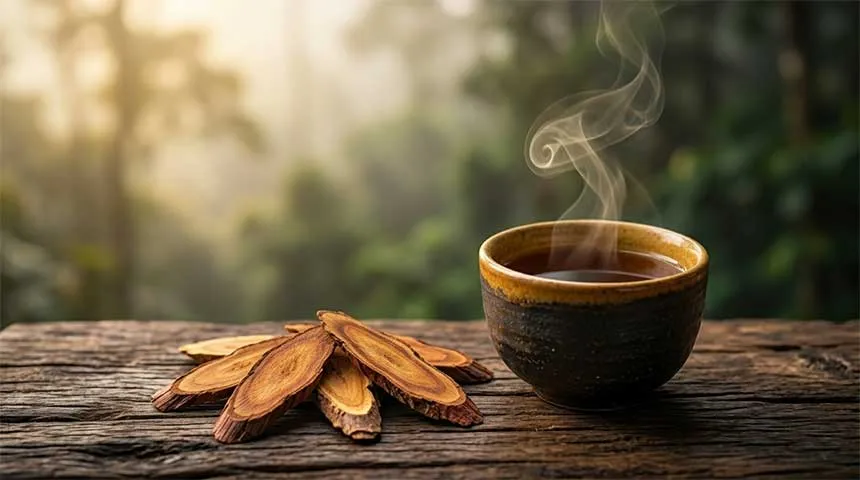
For those using wild-harvested Red Tongkat Ali root slices rather than processed extracts, the onset may be slightly more gradual — but many users report the experience as gentler and more sustained rather than the sharp spikes and crashes sometimes associated with high-ratio extracts.
Wild Red Tongkat Ali root slices from Pahang, Malaysia — from $59.90 USD →
Testosterone Changes: When Do They Become Measurable?
Testosterone changes are real but slower, and it is important to be honest about what the research actually shows. The studies do not claim dramatic overnight transformations. What they suggest is a meaningful, gradual restoration of levels that have declined with age — particularly in men whose testosterone is already below the optimal range.
| Study | Duration | Finding |
|---|---|---|
| Hamzah & Yusof, 2003 (Brit. J. Sports Med.) | 5 weeks | Improved lean muscle mass and strength in athletes |
| Talbott et al., 2013 (J. Int. Soc. Sports Nutr.) | 4 weeks | Significant improvements in stress hormones and mood |
| Ismail et al., 2012 (Evidence-Based Comp. Alt. Med.) | 1 month | Significantly increased testosterone in late-onset hypogonadism |
| Tambi et al., 2012 (Asian J. Andrology) | 1 month | Approximately 46% of men moved from subnormal to normal testosterone range |
The Tambi et al. (2012) result is notable: after one month of supplementation, a substantial proportion of men with below-normal testosterone reached normal levels. This does not mean Tongkat Ali replaces medical testosterone therapy when it is clinically indicated — but it suggests that for men in the low-normal or borderline range, the plant can make a meaningful difference within four to eight weeks.
For more detail on the hormonal research, see our in-depth piece on Tongkat Ali and testosterone research.
What Affects How Quickly You See Results
How long Tongkat Ali takes to work is not the same for everyone. Several factors influence your personal timeline significantly:
Your starting hormone levels. People with lower baseline testosterone or higher baseline cortisol tend to notice more pronounced changes, often sooner. Those already in the optimal range may feel subtler effects.
Consistency of use. Missing doses frequently disrupts the accumulation process. Daily use — even at modest amounts — appears to be more effective than sporadic high doses.
Form and quality of the root. Whole dried root slices, standardised extracts, and cheap powdered supplements are not equivalent. The bioactive content of poorly sourced or improperly processed Tongkat Ali can be negligible. See our comparison of Red vs Yellow vs Black Tongkat Ali for context on why variety and sourcing matter.
Age and metabolic health. Adults over 60 may find that changes take slightly longer to manifest but are no less real. Metabolic conditions such as obesity or insulin resistance can also slow the process.
Preparation method. Brewing root slices as a traditional decoction — as described in our how to brew Tongkat Ali guide — is a time-honoured method that may support better absorption for some users. Capsules and extracts offer convenience but vary enormously in quality.
Should You Cycle Tongkat Ali? Does It Affect Timing?
Cycling — taking Tongkat Ali for a defined period, then pausing before resuming — is a practice many experienced users follow. The rationale is to prevent the body from adapting and to give the endocrine system periodic rest. A common pattern is five days on, two days off, or three weeks on, one week off.
From a timing perspective, cycling means your cumulative weeks of use may take longer to achieve than if you took it continuously. However, many practitioners and users believe cycling supports sustained effectiveness over months and years rather than diminishing returns from unbroken daily use.
There is currently no definitive clinical guidance on optimal cycling schedules specifically for older adults, so personal adjustment based on felt experience remains the practical approach.
Traditional practice note: In Malaysian traditional medicine, Tongkat Ali root was typically brewed and consumed daily during periods of physical demand or recovery — not as a permanent daily supplement. This seasonal, purpose-driven approach aligns loosely with the concept of cycling.
What If You Feel Nothing After Several Weeks?
This happens, and there are usually identifiable reasons. Before concluding the herb does not work for you, consider:
Product quality. Cheap Tongkat Ali products — particularly those sold in bulk online without clear origin documentation — frequently contain negligible amounts of active compounds. Wild-harvested root from Pahang, Malaysia, the species’ native habitat, is meaningfully different from farmed or adulterated material.
Dose. There is no universally agreed therapeutic dose. Clinical studies have used anywhere from 100mg of standardised extract to 400mg or more. With root slices, the equivalent varies by preparation. If you have been using a very modest amount, consider whether your dose is sufficient.
Lifestyle factors. Tongkat Ali supports the body’s natural hormonal processes — it does not override them. Chronic sleep deprivation, high alcohol intake, obesity, and extreme caloric restriction all suppress testosterone independently. No herb compensates fully for these factors.
Patience. Twelve weeks is a more realistic trial period than four weeks for the full spectrum of benefits. If you have reached twelve weeks with consistent, quality product and noticed nothing, that is genuinely useful information — and you may want to discuss hormone testing with your doctor.
If you are considering Tongkat Ali and have concerns about safety or interactions, our Tongkat Ali side effects guide covers what to watch for, and what the evidence actually shows about risk.
A Realistic Summary for Adults Over 50
The experience of taking Tongkat Ali in your fifties or sixties is rarely dramatic. It does not feel like a pharmaceutical. What most people who respond well describe is a gradual normalisation — energy that is more consistent, sleep that is slightly deeper, a mood that is more even, and a sense of physical capacity that feels a little closer to how they remember feeling ten years ago.
That is not a small thing. But it takes time, and it takes quality.
If you are ready to begin with a properly sourced product, Wild Red Tongkat Ali root slices from Pahang, Malaysia — from $59.90 USD →
For more on how Red Tongkat Ali specifically may support men in this age group, see our article on Tongkat Ali for men over 50, and for women, our dedicated guide on Tongkat Ali for women.
Frequently Asked Questions
How long before I feel Tongkat Ali working? Most people notice early changes — particularly in energy and sleep — within two to four weeks. More meaningful results around testosterone, libido, and physical performance typically emerge between four and twelve weeks of consistent use.
Can I take Tongkat Ali every day? Yes, though many users cycle it (e.g., five days on, two off) to maintain effectiveness over the long term. Clinical studies have used daily supplementation for periods of four to eight weeks with positive outcomes.
Is Red Tongkat Ali different from Yellow in terms of how fast it works? Both come from Eurycoma longifolia. Red refers to the bark variety; yellow is the more widely available commercial form. The onset timeline is broadly similar, though potency depends heavily on sourcing, harvesting methods, and preparation. See our full comparison of root slices vs extracts for more detail.
⚠ Disclaimer: This article is for educational purposes only. Tongkat Ali is not approved by the FDA, UK MHRA, TGA, or any regulatory body to treat any medical condition. Consult your healthcare provider before use.